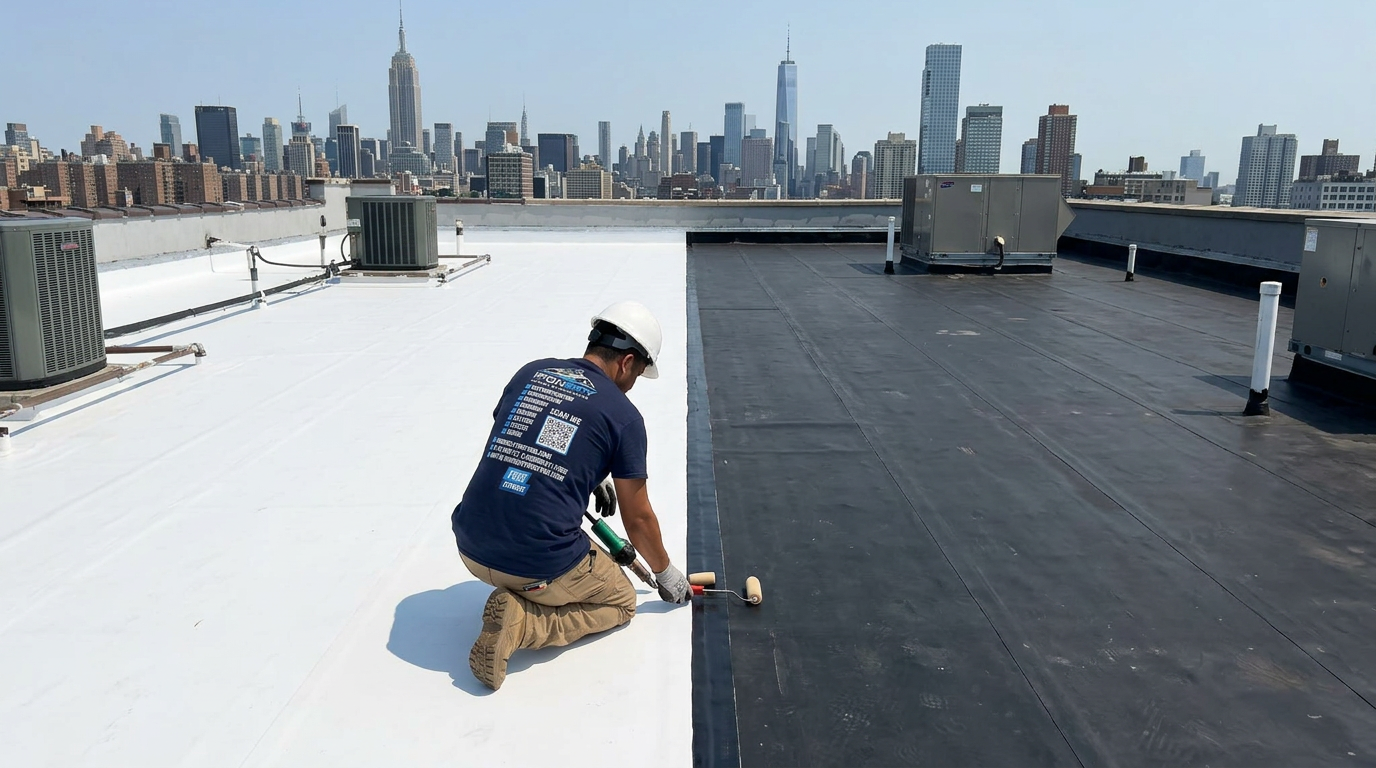
TPO vs EPDM Roofing — Which Is Better for NYC Buildings?
If you own a flat-roof building anywhere in the five boroughs and you're researching replacement, the conversation almost always narrows to two membranes: TPO and EPDM. Both are single-ply systems, both have decades of NYC track record, and both have legitimate fans among contractors. But they perform very differently on NYC roofs — and picking the wrong one for your specific building can cost tens of thousands of dollars over the next 25 years. This guide breaks down TPO vs EPDM roofing in NYC the way we'd explain it to a neighbor: what each material actually is, where each one wins, what they cost in 2025, and which one we install most often (and why).
What TPO actually is
TPO stands for Thermoplastic Polyolefin. It's a single-ply membrane manufactured in rolls and heat-welded at the seams during installation. Because the seams are welded rather than glued, they fuse into what is essentially one continuous sheet — which is the main reason TPO has become the dominant new-construction flat roof membrane in the U.S. over the past 15 years. Most TPO is bright white, which is its single biggest functional advantage in a city like New York: reflective roofs lower rooftop surface temperatures by 50–70°F on a summer afternoon, cutting cooling loads and extending HVAC life.
What EPDM actually is
EPDM stands for Ethylene Propylene Diene Monomer — a synthetic rubber membrane that's been used on U.S. flat roofs since the 1960s. It's installed in large sheets, is typically black, and uses adhesive, tape, or seam primer at the laps. EPDM has the longest real-world track record of any modern flat-roof system; roofs installed in the early 1980s are still in service today across NYC. It's also the most forgiving membrane in freeze-thaw cycles, which matters enormously here.
Pros and cons of TPO
Pros and cons of EPDM
Cost comparison in NYC (2025)
On a typical 1,500–2,500 sq ft NYC roof, expect roughly:
EPDM almost always wins on upfront price. TPO frequently wins on total cost of ownership for buildings with significant summer cooling loads, because the reflective surface can pay for itself in lower Con Ed bills within 5–8 years.
Which is better for the NYC climate
NYC throws everything at a flat roof: 95°F summers, sub-20°F winters, 30+ freeze-thaw cycles a season, salt air in coastal neighborhoods, and the occasional tropical storm. TPO handles heat and UV exceptionally well thanks to its reflective white surface. EPDM handles cold and structural movement exceptionally well thanks to rubber's natural flexibility. Both can last 25–30 years in NYC when installed correctly.
The deciding climate factor is usually solar exposure. South- and west-facing roofs that bake all summer are TPO territory. Heavily shaded roofs — common behind taller adjacent buildings in Park Slope, Bed-Stuy, and parts of Astoria — see less benefit from reflectivity, which makes EPDM's lower cost and cold-weather toughness the smarter pick.
Which is better by building type
Which IronSky recommends — and why
For roughly 70% of the NYC buildings we re-roof, we recommend TPO. The combination of welded seams, reflectivity, cooling savings, and modern warranty coverage is hard to beat for the typical NYC multifamily, commercial, or mixed-use building. For the other 30% — usually shaded brownstone rear roofs, tight-budget projects, or owners who specifically value EPDM's longer track record — we install EPDM and stand behind it just as confidently.
What matters more than the membrane is the install. A premium TPO roof rushed by an unqualified crew will fail in 5 years. A correctly installed EPDM roof from a manufacturer-certified contractor will last a generation. We're certified installers for the major manufacturers of both systems, which means our work qualifies for the full manufacturer warranty — not just our workmanship guarantee.
Get a real recommendation for your building
The honest answer to TPO vs EPDM roofing in NYC is: it depends on your building, your sun exposure, and your budget. The only way to get a real recommendation is to have a licensed roofer walk the roof, take measurements, and explain the tradeoffs in person. IronSky offers free, no-pressure flat roof consultations across all five boroughs — we'll walk your roof, photograph the existing conditions, and email you a written, itemized quote for both membrane options so you can compare side by side. Call (929) 994-0907 or request a free estimate online and we'll get you on the schedule, usually within 48 hours.
Get a Free Flat Roof Estimate
Licensed NYC roofers. Written, itemized quote. We respond within the hour during business hours.
- GAF Certified & Firestone Licensed
- Fully licensed & insured in NY State
- Free written estimate — no pressure
- Serving all 5 boroughs since 2008
Need a roofer in NYC?
IronSky offers free estimates and 24/7 emergency service across NYC, Long Island and Yonkers.
Get Free EstimateRelated Articles
All postsA side-by-side comparison of the two most popular flat roof systems in NYC.
Torch down roofing in NYC explained: how modified bitumen is installed, pros and cons, cost, lifespan, and which buildings it's best for in the five boroughs.
Flat roof replacement in NYC costs $8,000–$25,000+. Learn what affects pricing, TPO vs EPDM costs, and how to get the best quote from a licensed NYC roofer.