
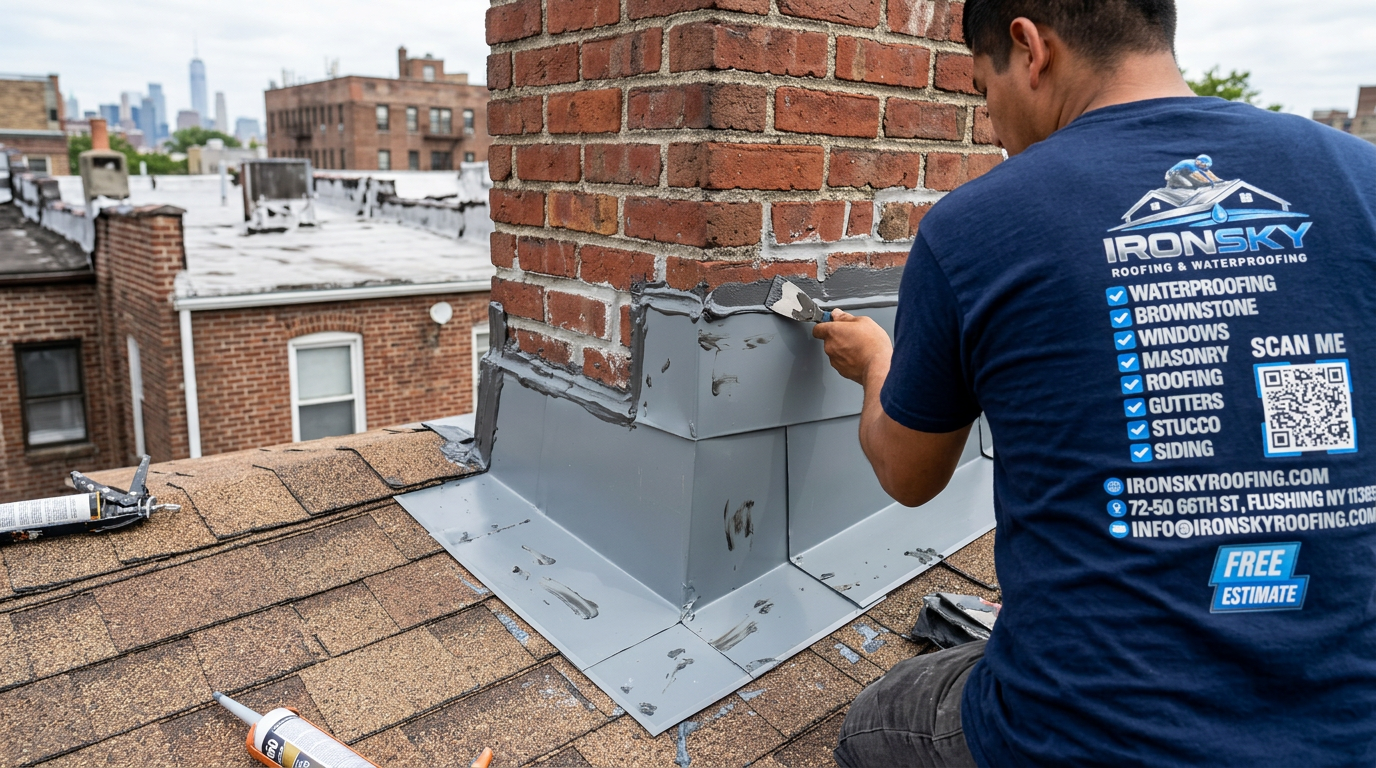
Chimney Flashing: The #1 Leak Source on NYC Roofs
After 20 years of inspecting NYC roofs, we can say with confidence: more leaks originate at chimneys than at any other single feature on a residential roof. It's not a close race. Chimneys interrupt the roof plane, they're built from materials that move and weather differently than the surrounding roof, and they sit at the highest point where wind-driven rain hits hardest. When the flashing fails — and it eventually does on every roof — water finds its way in, often traveling far from the actual entry point before showing up as a stain on a ceiling.
This guide explains why chimney flashing fails, what a proper repair looks like, and the warning signs that mean you need to act before the next storm.
How chimney flashing actually works
Flashing is the sequence of metal pieces that creates a watertight seal between the chimney and the roof. A complete chimney flashing system has four components, each of which has to be installed correctly for the system to work as a whole. The image below shows what properly installed chimney flashing looks like on a NYC residential roof — clean step and counter flashing, integrated with the surrounding shingles.
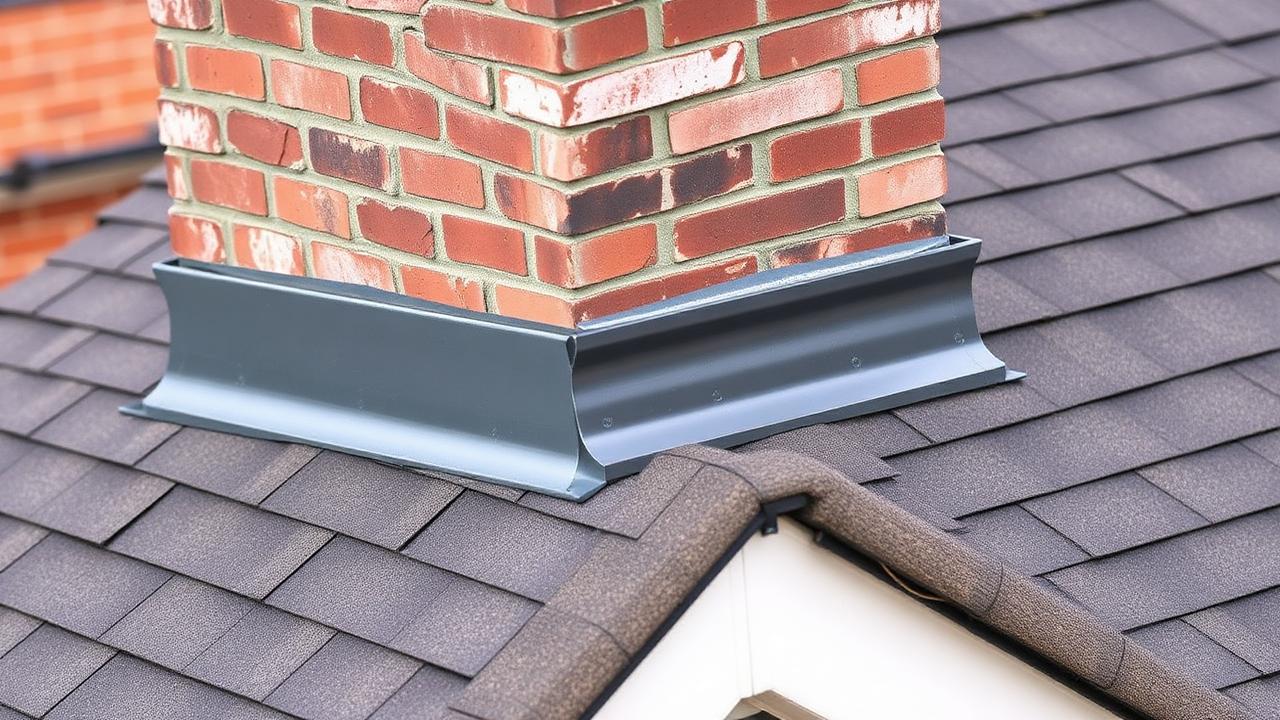
Step flashing
Individual L-shaped pieces of metal are woven into each course of shingles along the sides of the chimney. Each piece overlaps the one below it like roof shingles, so water always sheds onto the next piece down rather than backing up underneath.
Counter flashing
Embedded into the brick joints of the chimney itself, counter flashing covers the top edge of the step flashing. This is the piece that prevents water from running down the brick and behind the step flashing.
Apron (or front) flashing
A continuous piece of metal across the front of the chimney that ties into the shingles below.
Cricket (or saddle)
On chimneys wider than 30 inches, a small peaked structure built behind the chimney that diverts water around it rather than letting it pile up against the back wall.
When all four pieces are correctly installed, integrated, and sealed, the chimney is essentially waterproof. When any one of them fails, leaks begin.
Why chimney flashing fails
Several common failure modes account for the vast majority of chimney leaks we see:
Original installation shortcuts
Many older NYC homes were built with chimney flashing that was either poorly installed or simplified to save labor. Single-piece flashings, missing counter flashing, no cricket on a wide chimney — all of these are time bombs.
Caulk-only repairs
When a chimney leak develops, the easy fix is to slather caulk or roof cement over the suspected entry point. This works for one season at most. UV degrades the caulk, freeze-thaw cracks it, and the leak returns — usually worse, because the caulk now traps water against the metal and accelerates corrosion.
Mortar failure
The brick joints that hold the counter flashing in place eventually deteriorate. When they do, the counter flashing pulls loose and the entire system fails.
Galvanic corrosion
Mixing incompatible metals (galvanized step flashing with copper counter flashing, for example) causes galvanic corrosion that eats through the metal in a few years.
Roof replacement that didn't replace the flashing
The single most common cause of post-roof-replacement leaks is a roofer who shingled around the existing flashing instead of replacing it. The shingles look new; the flashing underneath is 30 years old and hanging on by rust.
What proper repair looks like
A real chimney flashing repair is more involved than most homeowners expect, which is why it's so often shortcut.
1. The shingles around the chimney are carefully removed
2. The old step, counter, and apron flashing is removed entirely
3. The roof deck around the chimney is inspected for rot and replaced as needed
4. Ice and water shield is installed around the entire chimney perimeter
5. New step flashing is woven into new shingles, course by course
6. New counter flashing is cut into the brick joints (the old joints are ground out, the flashing is set, and new mortar is installed to lock it in place)
7. A cricket is built behind chimneys wider than 30 inches
8. All metal-to-metal joints are sealed with high-quality polyurethane sealant — but the system is designed to be watertight without the sealant; the sealant is just insurance
Done correctly, this repair lasts 25-30 years.
Warning signs you should not ignore
Don't wait for the ceiling to start dripping. The following warning signs mean the flashing is already failing:
Any of these means it's time for a professional inspection.
What it costs
A complete chimney reflashing on a typical NYC home runs $1,500-$4,500 depending on chimney size, roof type, and access. That's vastly cheaper than the interior repairs that follow ignored chimney leaks — we routinely see $20,000+ in ceiling, drywall, and floor damage from chimney leaks that started as a $50 caulk job.
If you're getting any roof work done, have the roofer specifically address the chimney flashing in writing. A good roofer will recommend full reflashing as part of any reroof. A bad one will quote it as an extra and try to talk you out of it.
Get a Free Flat Roof Estimate
Licensed NYC roofers. Written, itemized quote. We respond within the hour during business hours.
- GAF Certified & Firestone Licensed
- Fully licensed & insured in NY State
- Free written estimate — no pressure
- Serving all 5 boroughs since 2008
Need a roofer in NYC?
IronSky offers free estimates and 24/7 emergency service across NYC, Long Island and Yonkers.
Get Free EstimateRelated Articles
All posts
Flat roof replacement in NYC costs $8,000–$25,000+. Learn what affects pricing, TPO vs EPDM costs, and how to get the best quote from a licensed NYC roofer.
From curling shingles to ceiling stains, here are the warning signs every NYC homeowner should know.
A side-by-side comparison of the two most popular flat roof systems in NYC.